
Formats · round robin
Round robin pickleball tournaments
The format that gives everyone the most pickleball. Here is how pairings, rounds and standings work, and when a round robin is the right call.
Updated By SkorX Team3 min read
How does a round robin pickleball tournament work?
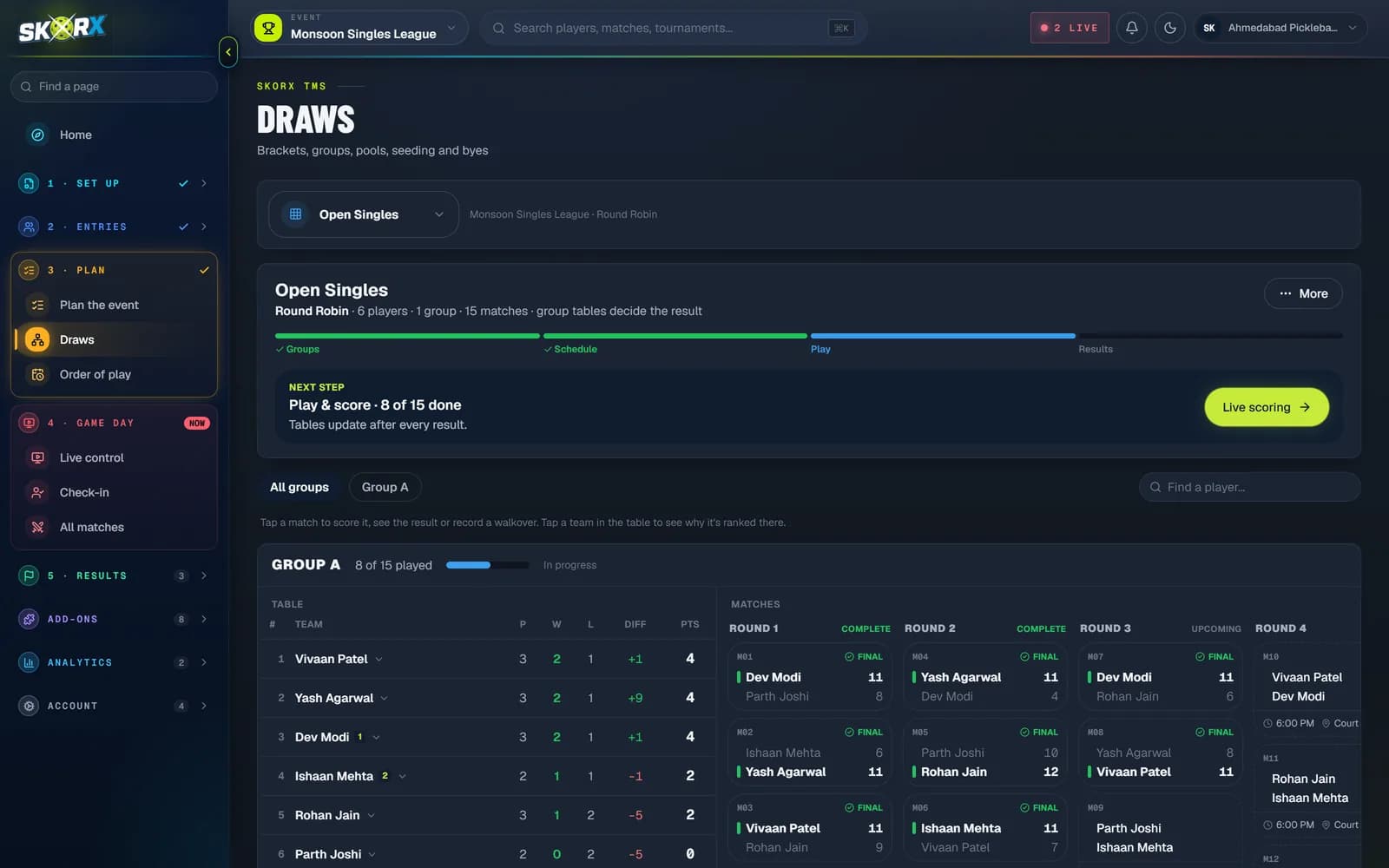
In a round robin pickleball tournament, every team in a group plays every other team once. A group of n teams needs n x (n - 1) / 2 matches, and each team plays n - 1 of them. Teams are ranked in a standings table by wins, with ties broken by head-to-head result, then game and point difference. With an odd number of teams, one team sits out each round.
At a glance
- Matches in a group
- n x (n - 1) / 2
- Matches per team
- n - 1
- Rounds
- n - 1 for an even group, n for an odd group
- Best group size
- 4 to 6 teams for one-day events
- Decided by
- Standings and tie-breakers
How many matches does a round robin need?
| Teams in group | Total matches | Matches per team | Rounds |
|---|---|---|---|
| 3 | 3 | 2 | 3 |
| 4 | 6 | 3 | 3 |
| 5 | 10 | 4 | 5 |
| 6 | 15 | 5 | 5 |
| 8 | 28 | 7 | 7 |
| 10 | 45 | 9 | 9 |
The match count grows with the square of the group size, which is why large divisions are split into pools. Eight teams in one group need 28 matches, while two groups of four need only 12.
How round robin pairings are made
The standard method is the circle method. Fix one team in place and rotate the others one position each round. Every team meets every other team exactly once, and no team plays twice in the same round. With an odd number of teams, add a placeholder; whoever is drawn against it has a bye that round.
How a round robin is decided
Teams are ranked by match points or wins. Ties are broken in a published order: usually head-to-head, then game difference, then point difference. See pickleball standings and tie-breakers for worked examples, including three-way ties.
Round robin variations
- Single round robin: every pair meets once. The default for tournaments.
- Double round robin: every pair meets twice. Common in leagues.
- Round robin into knockout: the top teams from the group play off in a bracket.
- Pool play: several small round robin groups feeding a knockout.
- Individual or rotating-partner round robin: partners change each round and players are ranked individually. Popular for social play.
When to use a round robin
Use a round robin when players value playing time over a quick result: small divisions, social events, leagues and group stages before a knockout. Avoid a single large group for a one-day event with many teams, because the match count outgrows your courts.
How to run a round robin
Choose group size
Four to six teams per group fits most one-day events.
Distribute teams
Use snake seeding so every group has a similar mix.
Generate rounds
Use the circle method so nobody plays twice in a round.
Publish tie-breakers
Announce the order before the first match.
Record full scores
Point difference needs every game score, not just the winner.
Rank and advance
Finalise standings and advance teams if a knockout follows.
Example: a four-team round robin
| Round | Court 1 | Court 2 |
|---|---|---|
| 1 | A v D | B v C |
| 2 | A v C | D v B |
| 3 | A v B | C v D |
Six matches over three rounds. With two courts, the group finishes in about three match slots.
Frequently asked questions
How many games are in a round robin of 4 teams?
Six matches over three rounds, and each team plays three.
How many matches does a round robin of 6 teams need?
Fifteen matches over five rounds, with each team playing five.
What happens with an odd number of teams?
One team has a bye each round, so the group needs one extra round. Five teams need five rounds.
How is the winner of a round robin decided?
By the standings: wins or match points first, then head-to-head, game difference and point difference.