
Organizer guide · brackets
Pickleball brackets, draws and seeding
A fair draw keeps the strongest teams apart until the end and gives byes to the teams that earned them. Here is how brackets and draws are built.
Updated By SkorX Team3 min read
How do you make a pickleball tournament bracket?
To make a pickleball tournament bracket, rank the entrants by seed, round the field up to the next power of two (4, 8, 16, 32) and give the difference as first-round byes to the top seeds. Place seeds 1 and 2 in opposite halves and seeds 3 and 4 in different quarters, then fill the remaining lines so higher seeds meet lower seeds first.
At a glance
- Bracket sizes
- Powers of two: 4, 8, 16, 32, 64
- Byes
- Next power of two minus entrants, given to top seeds
- Matches in a knockout
- Entrants minus 1
- Rounds
- Smallest power of two that fits the field: 12 teams need 4 rounds
- Seeding in SkorX
- Seeded or random, with snake seeding for groups
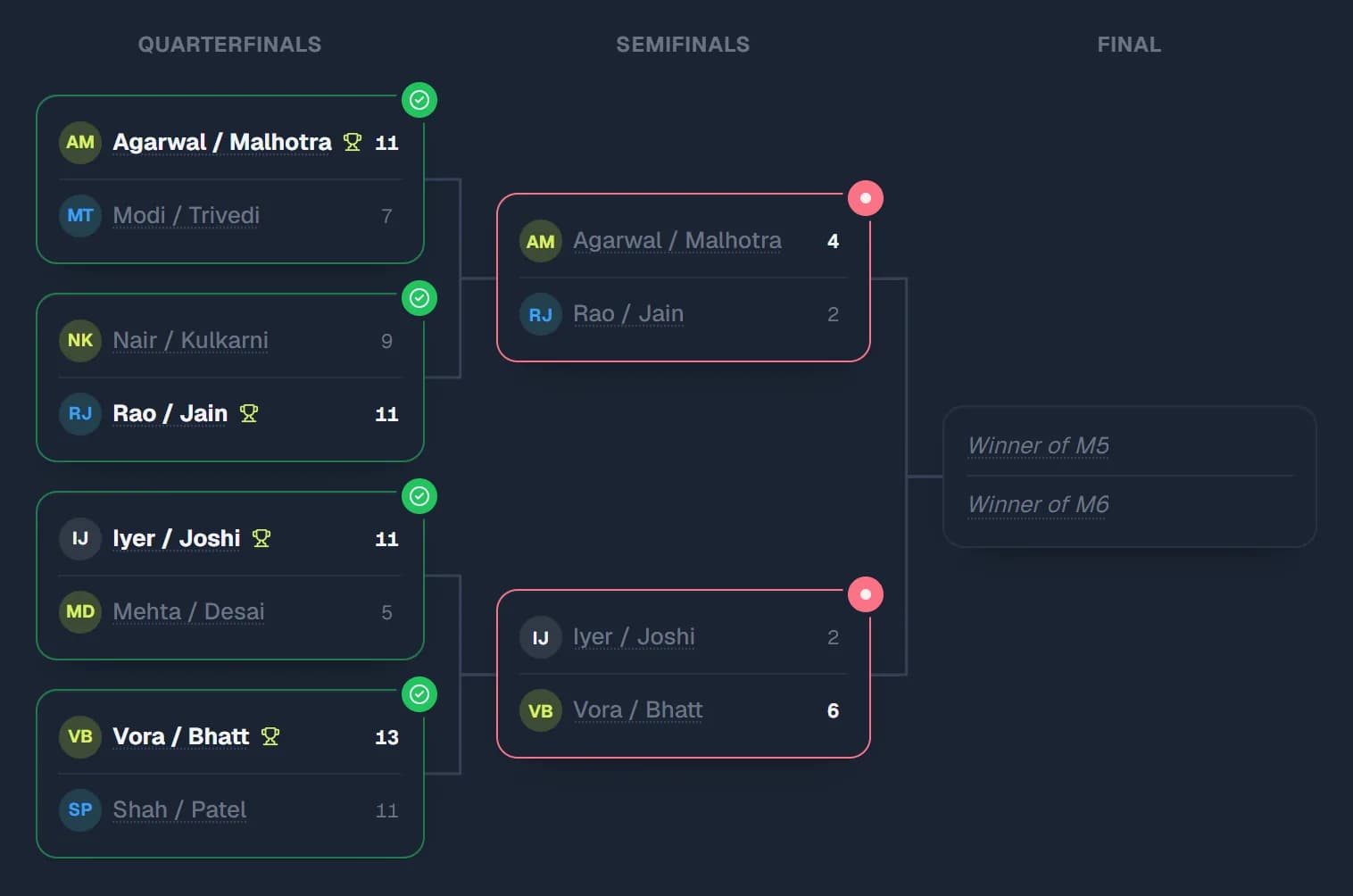
Draws and brackets: what is the difference?
The draw is the process of placing entrants into a competition structure. The bracket is the resulting knockout tree. Group stages have a draw too: entrants are distributed into pools. In both cases the aim is the same, to keep the strongest entrants apart early and make the path to the final fair.
Seeding
Seeds rank the entrants you expect to finish highest, usually from ratings, rankings or previous results. Seed 1 and seed 2 go to opposite halves of the bracket, so they can only meet in the final. Seeds 3 and 4 go into the two remaining quarters. Unseeded entrants fill the other lines, randomly or in rating order.
| Match | Top half | Match | Bottom half |
|---|---|---|---|
| 1 | Seed 1 v Seed 8 | 3 | Seed 3 v Seed 6 |
| 2 | Seed 4 v Seed 5 | 4 | Seed 2 v Seed 7 |
Byes
Brackets work in powers of two. When the field does not fill one, some entrants skip the first round with a bye. The number of byes is the next power of two minus the number of entrants: 12 teams in a 16-line bracket means 4 byes, which go to the top 4 seeds. A bye counts as progress, not a win, in most standings.
Draws for groups and pools
For pools, snake seeding spreads the strength evenly. With four pools, seeds 1 to 4 go into pools A to D, seeds 5 to 8 go back from D to A, and so on. Each pool ends up with a similar mix of strong and weaker teams. See pool play.
How to read a pickleball bracket
Read a bracket from the outside in. Each line is an entrant, each join is a match, and the winner moves one column toward the final. In double elimination there is a second, losers' bracket whose winner meets the winners' bracket champion in the grand final. See double elimination.
How to make a bracket, step by step
Close entries
The draw is only fair once the field is final.
Seed the entrants
Rank by rating, ranking or recent results. Decide how many seeds you need.
Pick the bracket size
Round up to the next power of two.
Assign byes
Next power of two minus entrants, to the top seeds.
Place the seeds
1 and 2 in opposite halves, 3 and 4 in different quarters.
Fill and publish
Place the remaining entrants and publish the bracket with the rules.
Common bracket mistakes
- Putting seeds 1 and 2 in the same half.
- Giving byes to random entrants instead of the top seeds.
- Placing partners or club-mates against each other in round one when a fair alternative exists.
- Changing the draw after publishing it without telling players.
Frequently asked questions
How many byes are in a 12-team bracket?
Four. A 12-team field uses a 16-line bracket, and the 4 empty lines become first-round byes for the top 4 seeds.
How many matches are in a 16-team single elimination bracket?
Fifteen. A knockout always needs one fewer match than the number of entrants.
Who gets a bye in a pickleball tournament?
The top seeds. Byes reward the entrants expected to go furthest.
Is there a pickleball bracket generator?
Yes. SkorX TMS generates seeded or random brackets and pools from your entries and advances winners as scores are entered.